

When you start learning Spanish, it’s easy to feel overwhelmed. You open a textbook or an app and suddenly there are hundreds of new words, verb charts, grammar rules, and exercises. Many beginners believe they need to memorize everything before they can start speaking.
But the truth is different. Language learning does not work like studying for a history exam. You don’t need to memorize long lists of vocabulary or every verb conjugation to begin communicating.
In fact, trying to memorize everything often slows down your progress. It creates pressure and makes learning feel heavy instead of practical and motivating.
A more effective way to study Spanish is to focus on active learning: listening carefully, noticing patterns, learning words in context, and using new language right away. When you approach Spanish this way, you start building real communication skills instead of just collecting information.
In this article, you’ll learn practical strategies to study Spanish as a beginner without trying to memorize everything, so you can build confidence and remember what you learn more naturally.
Start by Listening Actively
One of the most powerful habits you can develop when learning Spanish is active listening.
Many beginners listen to Spanish passively. They play a podcast, a video, or a lesson in the background, but they don’t pay close attention to how the language actually works.
Active listening is different. It means listening with a clear intention: noticing how words are used, how sentences are formed, and how speakers connect ideas.
For example, when you listen to a short conversation, try to focus on a few things:
- Which words repeat several times?
- How do speakers greet each other?
- How do they ask questions?
- What expressions seem useful for everyday conversation?
Instead of trying to understand every word, focus on the main idea and the patterns you hear.
Over time, your brain starts recognizing these patterns automatically. This makes it easier to understand Spanish and also helps you produce sentences more naturally when you speak.
Listening is not just a passive skill. When you listen actively, you are training your brain to recognize real Spanish in real situations.
Learn Words in Context, Not as Isolated Vocabulary
Another common mistake beginners make is studying vocabulary as long lists of individual words.
For example, you might see something like this:
- viajar – to travel
- reunión – meeting
- reservar – to reserve
- hotel – hotel
While it may seem useful at first, isolated words are difficult to remember because they don’t have a context.
Your brain remembers language better when it sees how words are used together.
Instead of learning the word viajar alone, it is much more effective to learn it in a sentence like:
“I want to travel to Mexico next year.”
Or instead of memorizing reunión, you might learn:
“I have a meeting at 10 in the morning.”
When words appear inside meaningful phrases, they become part of a real situation. This makes them easier to remember and much easier to use later.
Language is not just vocabulary. It is ideas expressed through sentences.

Focus on Ideas, Not Individual Words
When beginners study Spanish, they often worry about translating every word perfectly. This habit can slow down your learning and make speaking feel stressful.
Instead, try focusing on ideas.
For example, if you want to say something simple like:
“I’m looking for a restaurant nearby.”
You don’t need to know every possible vocabulary word related to food or restaurants. You only need the words that allow you to express that idea clearly.
This shift in mindset helps you communicate earlier in the learning process. You begin to think in terms of messages, not isolated vocabulary.
When you study phrases that express real ideas, you are preparing yourself for real conversations.
Take Notes You Can Review Later
Taking notes is another important part of learning Spanish effectively.
However, many students take notes that are difficult to use later. They write long lists of vocabulary or grammar explanations that they never review again.
Instead, your notes should help you remember useful language.
For example, when you study a lesson or listen to a conversation, write down:
- useful phrases
- example sentences
- expressions you think you might use
These notes become a small collection of language that is meaningful for you.
Later, when you review your notes, you are not just reading random words. You are revisiting ideas, phrases, and structures that you already saw in context.
This kind of review strengthens your memory and helps the language stay active in your mind.

Repetition Is Essential for Long-Term Memory
One of the most important principles in language learning is repetition.
It is normal to forget words the first time you learn them. This does not mean you are doing something wrong. It simply means your brain needs to see the information again.
Repetition works best when it happens over time.
For example, you might learn a new phrase today, review it tomorrow, see it again in a video later in the week, and use it in conversation the following week.
Each time you encounter the phrase, your brain strengthens the connection.
Eventually, the phrase becomes familiar and automatic.
Repetition does not mean repeating the same exercise many times in a row. It means meeting the same language in different contexts over time.
Practice Active Learning Instead of Passive Study
Another key idea for beginners is the difference between passive learning and active learning.
Passive learning happens when you only read or listen without interacting with the language. While this can help with exposure, it is usually not enough to develop speaking skills.
Active learning involves doing something with the language.
For example, after learning a new phrase, you might:
- say it out loud
- write a new sentence using the same structure
- imagine a real situation where you would use it
When you actively use the language, your brain processes it more deeply. This improves both understanding and memory.
Active learning also prepares you for real conversations, where you need to produce language quickly and naturally.

Start with the Most Common Verbs
Spanish verbs can feel intimidating because of their many conjugations. Beginners often see long charts with dozens of forms and feel that they must memorize everything.
In reality, you only need to start with a small group of very common verbs.
Verbs like:
- ser
- estar
- tener
- ir
- hacer
- querer
- poder
These verbs appear constantly in everyday Spanish. When you learn them with a few basic conjugations, you can already express many useful ideas.
For example, knowing simple forms like:
- I am
- I have
- I want
- I can
- I go
allows you to build many practical sentences.
Instead of memorizing entire conjugation tables, focus on the forms you will actually use most often. As you continue learning, you will naturally encounter other forms and expand your knowledge step by step.
Learn Phrases You Know You Will Use
One of the best ways to stay motivated as a beginner is to study language that is relevant to your life.
For example, if you are preparing for a trip, you might focus on vocabulary related to travel:
- ordering food
- asking for directions
- checking into a hotel
- talking to locals
If you need Spanish for work, you might focus on expressions used in meetings, introductions, or emails.
When you learn phrases connected to real situations, your brain recognizes their value. This makes them easier to remember and easier to use.
Studying language with a purpose is much more effective than studying random vocabulary.
Practice Shadowing to Improve Fluency
Shadowing is a powerful technique that many language learners use to improve pronunciation and fluency.
The idea is simple. You listen to a short piece of audio and repeat what you hear almost at the same time as the speaker.
This technique helps you develop several skills at once:
- pronunciation
- rhythm
- listening comprehension
- confidence speaking aloud
At first, it may feel difficult because native speakers talk quickly. But with practice, your mouth and brain begin to coordinate more easily.
Shadowing also helps you internalize natural sentence patterns, which makes speaking feel more automatic over time.
Even a few minutes of shadowing each day can make a noticeable difference in your fluency.
Learning Spanish Is a Process, Not a Race
Many beginners believe they must learn as quickly as possible. This pressure often leads to frustration and burnout.
Language learning is not about speed. It is about consistency.
When you listen actively, take useful notes, review your phrases, and use new words in context, you are building strong foundations.
Small, regular practice sessions are much more effective than trying to study large amounts of information at once.
Over time, the words and structures you see repeatedly begin to feel familiar. Conversations become easier, and your confidence grows.
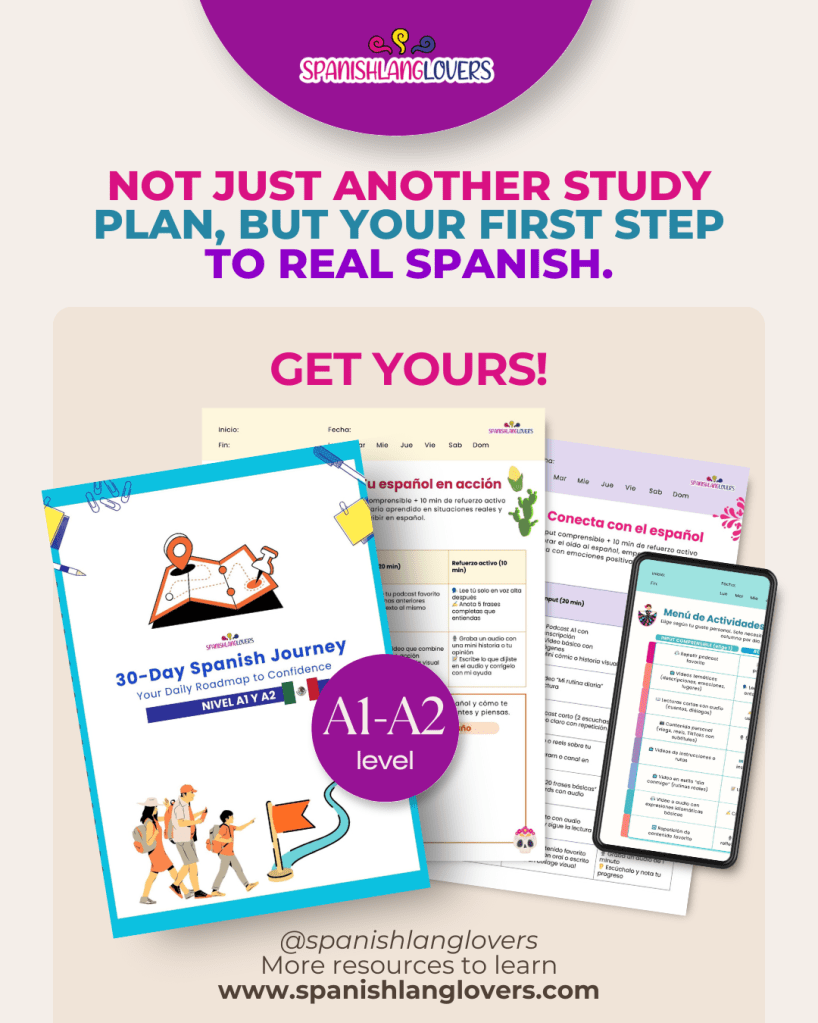
Download Your Study Planner
If you want to organize your learning and make these strategies easier to apply, a study planner can help you stay consistent and focused.
A good planner helps you track your practice, review vocabulary regularly, and plan listening and speaking activities throughout the week.
To make your study routine simpler, you can download my Spanish study planner and start organizing your learning today.
It will help you structure your practice, focus on the language that matters most, and make steady progress without feeling overwhelmed.
Learning Spanish does not require memorizing everything. With the right approach and consistent practice, you can build real communication skills step by step.
Descubre más desde Spanishlanglovers
Suscríbete y recibe las últimas entradas en tu correo electrónico.
